
Beyond choosing between liposuction or lipoabdominoplasty, the real difference does not lie in the procedure.
It lies in understanding what the body truly needs before any intervention takes place. And more importantly, in having an expert medical perspective capable of accurately interpreting each case.
Choosing a procedure without a thorough diagnosis is often what explains why some results do not look natural or simply fail to meet expectations.
At Cliniq, this process begins with the expert evaluation of our plastic surgeon, Dr. Isabel Uribe, who performs a detailed clinical assessment of the body, analyzing factors such as:
• how fat is distributed
• the quality of the skin
• the condition of the abdominal wall
• how these elements interact with each other
Based on this evaluation, the decision is not about which procedure to perform, but about how to design the most appropriate surgical approach for each individual patient.
Who is evaluating your body?
and under what clinical criteria is the surgery you truly need defined?
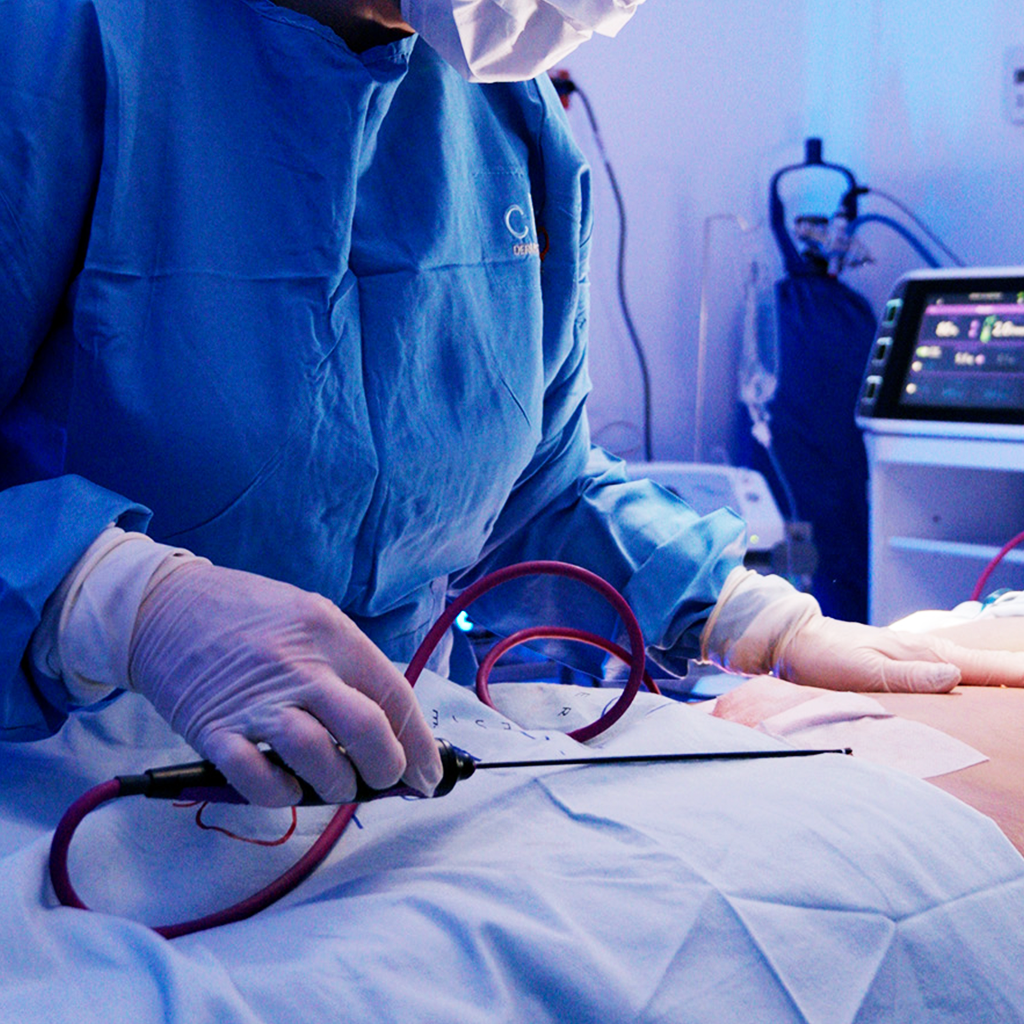
Technology and technique in plastic surgery: where results begin to take shape
The main difference between traditional body contouring surgery and technology-assisted procedures lies in the level of precision, the ability to achieve definition, and the impact on skin quality.
In many contexts, liposuction is still understood as a process of fat removal. However, when the goal is to achieve a harmonious result with definition, smooth transitions between areas, and improved tissue quality, multiple factors come into play.
At Cliniq, body contouring procedures are supported by advanced technologies such as Vaser, MicroAire, and Apyx One. These allow for more controlled tissue handling, enabling not only fat removal but also precise sculpting of the body’s contours.
This translates into more defined results, greater precision in complex areas, and an improved skin response during the postoperative period.
.
But this is where the difference becomes clear:
Technology does not replace surgical technique, nor does it guarantee a result on its own.
The true value lies in how everything is integrated within a surgical strategy that has been carefully defined from the initial diagnosis.
At Cliniq, this integration goes beyond the use of technology alone. It is the combination of Dr. Isabel Uribe’s technique, a specialized medical team, high-quality surgical supplies, and fully equipped in-house operating rooms designed exclusively for plastic surgery that elevates body contouring into a true specialty.
This approach allows us to go beyond conventional liposuction.
For example, with high-definition techniques—even when integrated into procedures such as lipoabdominoplasty—it is possible to work in deeper anatomical planes with greater control, enabling the removal of larger volumes of fat with less bleeding.
This not only expands the range of patients who can be treated, including those with higher body weight or greater fat volume, but also directly improves the quality of the outcome:
better skin retraction, a lower risk of fibrosis, fewer irregularities, and a smoother recovery process.
It is at this level of precision that results are truly defined.
And this explains why two patients can undergo liposuction or lipoabdominoplasty and achieve completely different outcomes: the difference lies in clinical judgment, the technology used, and the experience of the surgical team.
Where the right decision becomes the result.
Ultimately, body contouring surgery is not about choosing between liposuction or abdominoplasty, nor about accessing a specific technology.
It is about understanding that the outcome does not begin in the operating room, but in how the body is assessed, how the strategy is defined, and how each step is executed with precision.
At Cliniq, this way of doing things has transformed body contouring into a specialty of its own—one where every case is approached with clear clinical judgment, detailed planning, and an environment designed exclusively to achieve consistent results.
That is why, beyond technique or procedure, what truly makes the difference is the coherence between diagnosis, execution, and medical expertise.
And this is where the decision stops being an aesthetic choice…
and becomes the right one.